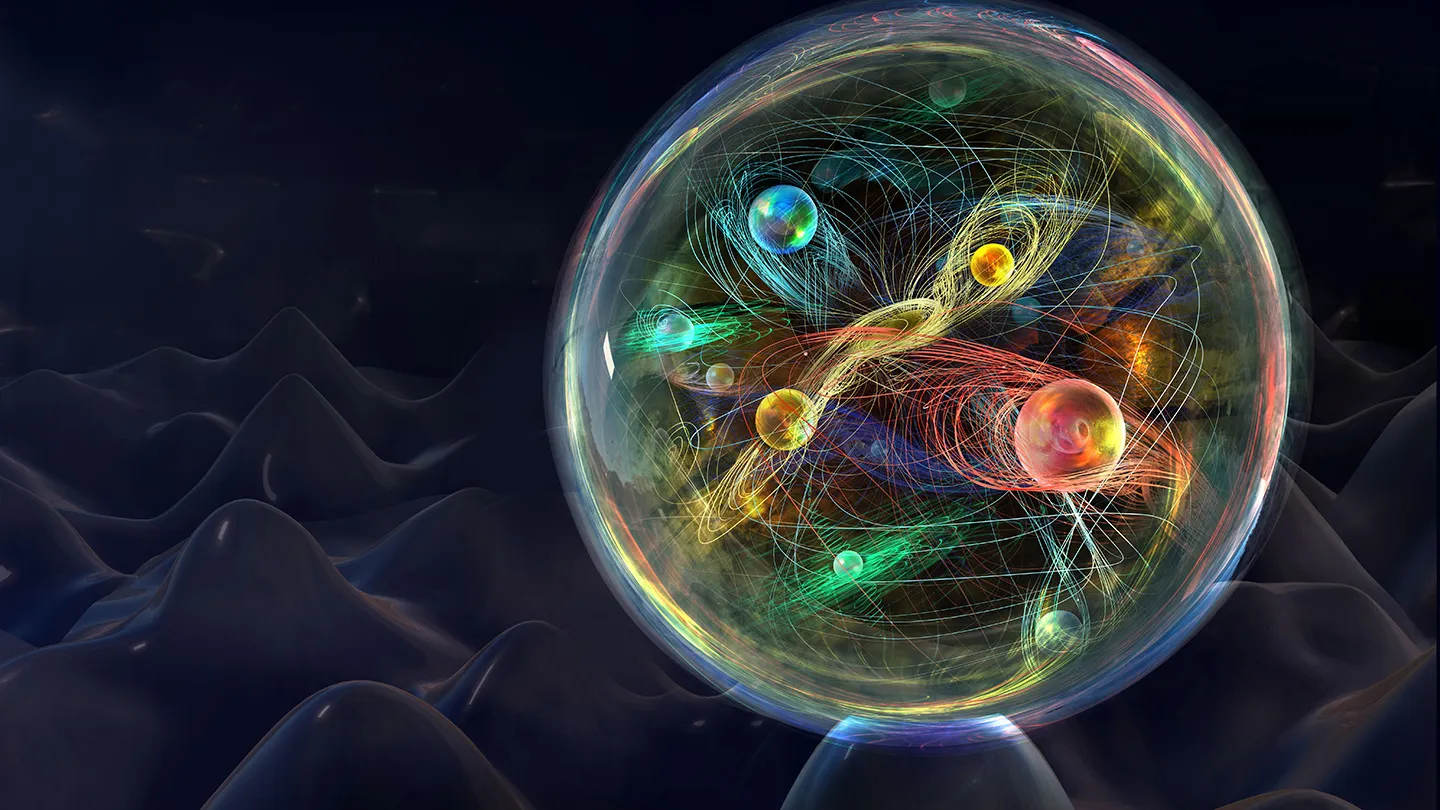
innovuscollege.com – The Higgs boson, often dubbed the “God particle” (a term popularized by Leon Lederman’s book but disliked by scientists), is one of the most significant discoveries in modern physics. This elementary particle completes the Standard Model of particle physics, explaining how other particles acquire mass. Without it, the universe as we know it—filled with stars, planets, and life—would not exist, as particles would zip around at the speed of light with no mass.
The Theoretical Origins
The Higgs boson was proposed in 1964 by six physicists working in three independent groups: Peter Higgs (University of Edinburgh), François Englert and Robert Brout (Université Libre de Bruxelles), and Gerald Guralnik, Carl Hagen, and Tom Kibble. Their papers described a mechanism—now called the Higgs mechanism—that gives mass to gauge bosons (like W and Z particles) through spontaneous symmetry breaking.
The analogy often used is the Higgs field, an invisible field permeating all space, like a “molasses” that particles interact with. Massless particles pass through easily, while others “drag” and gain mass. The potential of this field resembles a Mexican hat, with the boson as excitations in the field.
Discovery at CERN
The Higgs boson was discovered on July 4, 2012, at the Large Hadron Collider (LHC) at CERN in Switzerland—the world’s largest particle accelerator, a 27-km underground ring smashing protons at near-light speeds.
Two experiments, ATLAS and CMS, independently observed a new particle with a mass of about 125 GeV/c² (roughly 133 times the proton’s mass). By 2013, it was confirmed as the Higgs boson. The announcement was a global sensation, marking the last missing piece of the Standard Model.
Properties and Significance
- Spin-0 scalar boson: Unique as the only known fundamental particle with zero spin.
- Unstable: Decays almost instantly (in 10⁻²² seconds) into other particles like photons, W/Z bosons, or bottom quarks.
- No electric charge or color charge.
Its discovery validated the Higgs mechanism, explaining mass for W and Z bosons (mediators of weak force) and, via Yukawa couplings, for fermions like quarks and electrons.
Ongoing Research and Future
Post-discovery, LHC studies have confirmed the Higgs behaves as predicted, coupling to particles proportionally to their mass. Deviations could hint at new physics, like supersymmetry or dark matter.
The High-Luminosity LHC (starting ~2029) will produce more Higgs bosons for precise measurements. Questions remain: Is there only one Higgs? Why is its mass 125 GeV? Does it relate to dark energy or inflation?
The Higgs boson is more than a particle—it’s a window into the universe’s fundamental workings, a triumph of human curiosity and collaboration.
About the Author